Renovatio Historia


Renovatio Historia es una página que pretende difundir la historia desde una perspectiva novedosa, renovadora, que acerque el conocimiento de la historia a cualquier persona rompiendo con el viejo lenguaje sin que por ello se pierda el carácter verídico y profesional que el conocimiento histórico requiere y necesita.


Para ello se presentan los temas a través de los nuevos medios audiovisuales y se apoya y difunde la investigación más puntera en el campo historiográfico.


Power Point, youtube y el cine comercial son armas de la docencia.


La Norma Hipotética, las Bases de Datos, la criminalidad y las matématicas son armas de la investigación histórica más seria y puntera pero no por ello encorsetada y arcaizante.


Raúl Ramírez Ruiz

Universidad Rey Juan Carlos (Madrid)

"La historia es la clave. Su olvido la causa". R3.
"我希望可以通过我的研究能够让广大西语读者走近中国". R3


domingo, 22 de diciembre de 2024

The New Spanish Sinology: Origin and present of Chinese studies in Spain. A study from its origin (1978) until today. Panel 1 of the Beijing Academic Session of the Second Conference of World Sinologists: : Chinese Classics and Sinology.

On October 30th, I had the honor of sharing with Liliana Arsovska the Panel 1 discussion, entitled, "Chinese Classics and Sinology" at the Beijing Academic Session of the Second Conference of World Sinologists.


Panel 1: Chinese Classics and Sinology
Liljana Arsovska (Mexico); Raul Ramirez Ruiz (Spain); 
Wang Yinquan; Du Yunhui; Fang Ming; Sun Xintang (China)


Second Conference of World Sinologists

1. Organization

Hosted by: China Association for International Understanding

Organized by: Beijing Language and Culture University

Co-organizers: World Sinology Center, Chinese Culture Translation and Studies Support Network (CCTSS)

Itinerary
Conference Dates: October 27 - 31, 2024


Ramírez-Ruiz on the stand moments before speaking on:
The New Spanish Sinology: Origin and present of Chinese studies in Spain. A study from its origin (1978) until today. 
Beijing, 30/10/2024.


PART II
October 30 (Morning)
Opening of the Beijing Academic Session of the Second Conference of World Sinologists
Opening Remarks
Speeches by Sinologists

Keynote:
Aesthetic and Scientific Methodology in Global Sinology, by Christoph Harbsmeier (Germany)
Poetic China: Hermeneutics for Civilizational Dialogue, by Han Jingtai

[Panel Discussions)
Panel 1: Chinese Classics and Sinology
Liljana Arsovska (Mexico)
Raul Ramirez Ruiz (Spain)

[China]
Historical Accuracy in Sinology Research: How does A Small Error Lead to a Huge Discrepancy, by Wang Yinquan
Understanding the Subjectivity of Chinese Culture, by Du Yunhui
Fang Ming, Professor, Beijing Language and Culture University

The New Spanish Sinology: Origin and present of Chinese studies in Spain. A study from its origin (1978) until today. 

Raúl Ramírez Ruiz
Universidad Rey Juan Carlos. 
Beijing, China
Beijing Language and Culture University
30/10/2024


Ramírez-Ruiz during his speech on: 
The New Spanish Sinology: Origin and present of Chinese studies in Spain. 
A study from its origin (1978) until today.
Beijing, 30/10/2024.


During his speech, Professor Ramírez-Ruiz spoke about "The New Spanish Sinology: Origin and present of Chinese studies in Spain. A study from its origin (1978) until today", following the recent appearance of the work "Asian Studies in Spain: Analysis, Evolution and Perspectives".
 

The New Spanish Sinology: Origin and present of Chinese studies in Spain. A study from its origin (1978) until today (Abstract).

The current sinology in Spain in a recent construction; we can date their beginning to the mid-1980s, under the impetus of the Reform and Opening of China. Its consolidation through official degrees did not occur until the beginning of the 21st century. Specifically in 2003, with the emerging second-cycle Bachelor's degrees from some universities that began to offer the teaching of Chinese studies. 

Twenty years after those initial steps, experts, professors and universities that teach undergraduate and master's degrees in Chinese studies saw the need to carry out an in-depth investigation of the degrees in both Chinese and Asian studies in force. This pharaonic work fell to the Consolidated Research Group on Spain-China Relations of the URJC. 

The work resulting from this work appeared at the beginning of 2024 and was divided into four large sections: 

Firstly, the origin of all the centers of sinology and Asian studies in Spain was analyzed; 

Secondly, the construction of the institutional system of Chinese and Asian studies in each Spanish university was explained; 

Thirdly, all the official and private Chinese study titles offered were analyzed one by one; 

Fourthly, a statistical analysis of all the previous information was carried out (to understand the underlying dynamics and try to understand its why); 

Fifth and last, twelve proposals for improvement for the future were offered.


Panel 1: Chinese Classics and Sinology
Beijing Academic Session of the Second Conference of World Sinologists


As can be seen, the work plan was not limited to a simple cataloging of what existed, but rather intended to review the historical dynamics of the degrees, the type of student body, university fees, levels of employability, and the geographical distribution of the degrees. , etc. in order to be able to understand what the real characteristics of our Chinese studies in Spain were, from there, to be able to propose improvement actions. The director of the book, Dr. Raúl Ramírez Ruiz, will offer a panoramic and academic Spanish vision of Chinese studies in Spain, answering three fundamental questions of this work: Why? The fact that? And for what?


Renovatio Abroad. 

viernes, 20 de diciembre de 2024

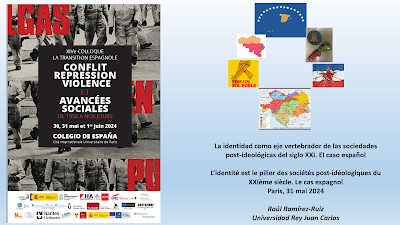
La identidad como eje vertebrador de las sociedades post-ideológicas del siglo XXI. El caso español

“La identidad como eje vertebrador de las sociedades post-ideológicas del siglo XXI. El caso español” fue la Ponencia presentada Raúl Ramírez-Ruiz durante el "XIV COLOQUIO LA TRANSICIÓN ESPAÑOLA: CONFLICTO, REPRESIÓN, VIOLENCIA Y AVANCES SOCIALES, DE 1956 A LA ACTUALIDAD" que se celebró en París del 30 de mayo al 1 de junio de 2024, organizado por el Colegio de España de París, le Centre de Recherches bériques et Ibéro Ibéro-américaines (EA369) de l’Université Paris Nanterre, l’Institut des Mondes Anglophone, Germanique et Romanes (EA3958) de l’Université Paris Est-Créteil Val de Marne, el Grupo de Estudios de Historia Actual (GEHA, PAI-HUM315) de la Universidad de Cádiz, y la Asociación de Historia Actual (AHA).

Grândola, Vila Morena
Símbolo de una nación,
Maybe, el único estado-nación de la Penísula Ibérica,
en los tiempos de la "identidad". 

El 50º Aniversario de la Revolución de los claveles, el 25 de abril de 2024, 
la juventud de Lisboa se reunió en el Largo do Carmo para cantar "Grândola, Vila Morena" 
y así conmemorar el nacimiento del Portugal democrático. 
Este video, fue fundamental para la exposición de la ponencia:
“La identidad como eje vertebrador de las sociedades post-ideológicas del siglo XXI. El caso español”. R3


La identidad como eje vertebrador de las sociedades post-ideológicas del siglo XXI. El caso español

L’identité est le pilier des sociétés post-idéologiques du XXIème siècle. Le cas espagnol

Paris, 31 mai 2024

Raúl Ramírez-Ruiz

Universidad Rey Juan Carlos

Portada de la Power Point de la Presentación de Ramírez-Ruiz


I.- ¿POR QUÉ IDENTIDAD?


F. Fukuyama dixit: 

"Este libro no se hubiera escrito si Donald J. Trump no hubiera sido elegido presidente en noviembre de 2016 [....] En todo el espectro ideológico, la política de la identidad es la lente a través de la que se miran hoy casi todos los problemas sociales".

Fukuyama empezó sulibro Identidad, danod explicaciones no pedidas, respondiendo a la pregunta ¿Cuál fue el acontecimiento X que invalidó su tesis?

1.- No se entendió su "Fin de la historia":  “Fin” en el sentido hegeliano-marxista … la palabra Fin no significa “terminación” sino “meta” u “objetivo” …. Es decir desarrollo o modernización… los dos problemas que ha detectado en su teoría son la:

2.- La dificultad de desarrollar un Estado Moderno e impersonal (se refirió a este problema como “llegar a Dinamarca”).

3.- La posibilidad de que una democracia liberal moderna decaiga o retroceda.


Las fuentes fundamentales de este trabajo.


II.- BASES DEL MUNDO ACTUAL


- Choque de civilizaciones

- Las Globalización

- El Toyotismo

- Las migraciones


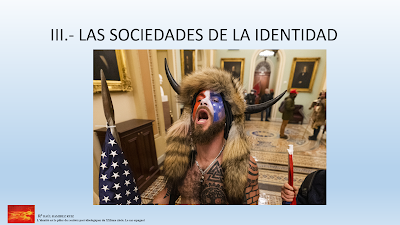
III.- LAS SOCIEDADES DE LA IDENTIDAD


LA GLOBALIZACIÓN … REDUJO LA POBREZA GLOBAL… PERO …

En algún momento a mediados de la segunda década del siglo XXI, la política mundial cambió drásticamente.

El periodo desde principios de la década de 1970 hasta mediados de 2000 se vivió lo que Samuel Huttington llamó la “tercera ola” de democratización … de 35 a más de 110

En paralelo al cambio en las instituciones políticas se produjo un correspondiente crecimiento de la interdependencia económica entre los países … lo que llamamos globalización … incremento de la prosperidad “el número de personas que viven en la pobreza extrema en los países en vías de desarrollo disminuyó del 42% de la población total en 1993 al 17% en 2011. Las muertes infantiles menores de 5 de 22% al 5%.

Pero en las democracias desarrolladas la desigualdad aumentó drásticamente


1.- SE NECESITA RECONOCIMENTO. LA RIQUEZA, NO HA BASTADO

2.- SE AÑORA LA ÉPICA. SOCIEDADES CON NECESIDADES CUBIERTAS, PERO SIN ÉPICA.

3.- PERO NO TODO SE DEBE A LO MATERIAL. EL NEO-NACIONALISMO ¿IRRACIONAL?

4.- LA POLITICA DEL RESENTIMIENTO


IV.- LA IZQUIERDA BUSCA SU SITIO


Una de las características más sorprendentes de la política global de la segunda década del siglo XXI es que las nuevas fuerzas dinámicas que la conforman son partidos y políticos nacionalistas o religiosos, las dos caras de la política de la identidad, en lugar de los partidos de izquierda de clase, tan prominentes en la política del siglo XX.

Por el contrario, la vieja izquierda de clase ha entrado en prolongado declive en todo el mundo. El comunismo colapsó en 1989-1991, solo versiones residuales de él sobrevivieron. La socialdemocracia que configuró la Europa post-bélica no ha dejado de retroceder (de más del 40% de los votos al 20%).

En muchos aspectos la debilidad global de la izquierda sorprende, dado el aumento de la desigualdad global dentro de cada país.


V.- LE CAS ESPAGNOL: 
O la mutación del Estado Español en un mero ente administrativo sin alma ni nación.


La visión “católica” es decir “universal” de la idea de “ser” español, lleva a que la ambigüedad de la definición “nacional” nos haya permitido existir a lo largo de los siglos. Si bien ahora, en la era de la “identidad” esa misma idea permite sobrevivir al estado-nación español con una forma que desde la ironía cínica defino como como el Estado Estatal:

El Estado Estatal es

“Un ente administrativo, sin alma ni nación que parasita el cadáver de lo que un día fue España”. R3


Pero el cadáver se descompone, o los parásitos lo terminan devorando completamente … en ambos casos tiende a desaparecer.

Y ahí, entra la situación actual. Tenemos un Estado gobernado por una coalición de la izquierda de lengua castellana con movimientos “identitarios” autodefinidos como “otros”, “distintos”.

Con ello se ha conseguido mover el foco o la perspectiva desde una división identitaria (étnica) hacia otra, de apariencia, ideológica, “el muro”.

Esta situación, inmensamente ambigua y peligrosa, crea un “nosotros” con los movimientos nacionales/etnicistas no castellanos, los envuelve y los implica en el gobierno de la “odiada España”.

Es un “nosotros”, racionalmente hablando, contra-natura … pero, salva la existencia de ese Estado sin nación (tampoco multinacional a lo Austro-Hungría) con una frontera exterior común y una monarquía simbólica en diversos sentidos.  


El diseño de la bandera propuesta para la España post-española (Estado Estatal) 
fue vista por primera vez en @electo_mania


Reseña libro Francis Fukuyama, Identidad. La demanda de dignidad y las políticas de resentimiento, Trad. por García Maldonado, A., Barcelona, Planeta/ Deusto, 2019, 206 pp.: 


París, 1 de mayo de 2024.


Renovatio Estatalino. 

jueves, 19 de diciembre de 2024

Chinese (&Asian) Studies in Spain: Analysis, Evolution & Perspectives. Nanping 27/10/2024. 第二届世界汉学家大会日程

CHINESE (& ASIAN) STUDIES IN SPAIN: ANALYSIS, EVOLUTION AND PERSPECTIVES.

The Second Conference of World Sinologists 
第二届世界汉学家大会日程 
Nanping, Fujian 27-28 October 2024 

Raúl Ramírez Ruiz 
Universidad Rey Juan Carlos Madrid (Spain) 


Chinese Studies in Spain are a recent construction; we can date their beginning to the mid-1980s, under the impetus of the Reform and Opening of China. Its consolidation through official degrees did not occur until the beginning of the 21st century. Specifically in 2003, with the emerging second-cycle Bachelor's degrees from some universities that began to offer the teaching of Chinese studies. 


A New Spanish Sinology apppeared. 
第二届世界汉学家大会日程.

A moment from Ramírez-Ruiz's intervention at the 
Second Conference of World Sinologists,
第二届世界汉学家大会日程, 
 he lectured:
"Chinese (&Asian) Studies in Spain: Analysis, Evolution & Perspectives." 
Nanping 10/27/2024.


Twenty years after those initial steps, experts, professors and universities that teach undergraduate and master's degrees in Chinese studies saw the need to carry out an in-depth investigation of the degrees in both Chinese and Asian studies in force. This pharaonic work fell to the Consolidated Research Group on Spain-China Relations of the URJC. 

The work resulting from this work appeared at the beginning of 2024 and was divided into four large sections: 

Firstly, the origin of all the centers of sinology and Asian studies in Spain was analyzed; 

Secondly, the construction of the institutional system of Chinese and Asian studies in each Spanish university was explained; 

Thirdly, all the official and private Chinese study titles offered were analyzed one by one; 

Fourthly, a statistical analysis of all the previous information was carried out (to understand the underlying dynamics and try to understand its why); 

Fifth and last, twelve proposals for improvement for the future were offered.


As can be seen, the work plan was not limited to a simple cataloging of what existed, but rather intended to review the historical dynamics of the degrees, the type of student body, university fees, levels of employability, and the geographical distribution of the degrees. , etc. in order to be able to understand what the real characteristics of our Chinese studies in Spain were, from there, to be able to propose improvement actions. The director of the book, Dr. Raúl Ramírez Ruiz, will offer a panoramic and academic Spanish vision of Chinese studies in Spain, answering three fundamental questions of this work: Why? The fact that? And for what?


Origen y presente de los estudios chinos en España (In Spanish. Possibly the best lecture on the topic on the list above): https://youtu.be/WFoX7cDEXLk?si=kheCraxUG1q0CjY2


Renovatio Abroad.

martes, 17 de diciembre de 2024

Confucianism: an underestimated way (in the West) to understand China in the global world. Raúl Ramírez Ruiz. International Conference to commemorate the 2575th Anniversary of Confucius’s Birth. “纪念孔子诞辰2575 周年国际学术研讨会暨国际儒学联合会第七届会员大会”

Confucianism: an underestimated way (in the West) to understand China in the global world. 

Raúl Ramírez Ruiz


Last December we spoke in a “Dialogue among European Members-Friends of International Confucian Association (ICA)” about how the reception of Confucianism and other Chinese philosophies are an underrated path to mutual understanding.


The fundamental idea behind that presentation and the one I present at this new ICA meeting is the same: the West fears China because it believes that China, with the power it currently holds in the world, will behave towards other countries like any other. Western power would be, compared to the power that China currently has.

After years studying Chinese civilization, I believe that this fear is based on a mistake in perception. The West reflects in China its ways of thinking and seeing the world. Analyzes present actions and forecasts China's future actions based on Western values ​​or parameters. The West does not stop to analyze the reason for each of China's actions in light of China's philosophy, way of thinking or the meaning of history.

International Conference to commemorate the 2575th Anniversary of Confucius’s Birth and the 7th Congress of the International Confucian Association


“纪念孔子诞辰2575 周年国际学术研讨会暨国际儒学联合会第七届会员大会”


The year 2024 marks the 2575th anniversary of Confucius’ birth, the 0th anniversary of the founding of the International Confucian Association (ICA), and the year for the ICA congress and the election meeting for its new leadership. Following the constitution of the ICA, we plan to hold the International Conference in Honor of the 2575th Anniversary of Confucius’ Birth and the 7th Congress of the International Confucian Association in mid to late October 2024 in Beijing, China. 

The conference, whose theme is “Confucianism: Diversity of Civilizations and Modernization”, aims to promote the essence of Confucian culture, explore the significant role of Confucianism in global modernization, and foster mutual learning among civilizations and international people-to-people exchanges. Sub-forums on the diversity of civilizations and mutual learning, innovative development of cultural heritage, the common values of humanity, and international people-to-people exchanges will be held.

Wang Huning (王 沪宁) en la inauguración 7th Congress of the International Confucian Association.


The theme of the five-day conference is Confucianism: Diversity of Civilizations and Modernization. It will include four sub-forum themes:

(1) Diversity of Civilizations and Mutual Learning
(2) Inheritance and Innovative Development of Traditional Culture
(3) Shared Values of Humanity
(4) International Cultural Exchange


Sun Chunlan (孙春兰) en la Inauguración del 7th Congress of International Confucian Association


Renovatio Abroad.

Los estudios asiáticos en España: análisis, evolución y perspectivas. Presentación Raúl Ramírez Ruiz. Universidad de Valladolid.

El pasado 12 de abril de 2024 en la Facultad de Comercio de la Universidad de Valladolid y gracias a la invitación conjunta del Centro de Estudios de Asia de la UVa y de la dirección del Máster Universitario en Relaciones Internacionales y Estudios Asiáticos de la Universidad de Valladolid se presentó la obra “Los Estudios Asiáticos en España Análisis, Evolución y Perspectivas”. 

"Los estudios asiáticos en España: análisis, evolución y perspectivas" (Aranzadi 2024) es fruto de la colaboración entre la Universidad Rey Juan Carlos (URJC) y Casa Asia, y analiza la oferta de estudios asiáticos en España y su evolución en los últimos años, para sobre esa base extraer conclusiones y llevar a cabo acciones de mejora. 

En este vídeo presentamos las palabras del Director y primer autor de la misma, Dr. Raúl Ramírez Ruiz, Director del Grupo de Investigación Consolidado en Relaciones España China de la URJC.


Los Estudios Chinos en España son una construcción reciente; podemos datar su inicio a mediados de la década de 1980, bajo el impulso de la Reforma y Apertura de China. Su consolidación a través de titulaciones oficiales no se produjo hasta principios del siglo XXI. Concretamente en 2003, con los emergentes títulos de Grado de segundo ciclo de algunas universidades que comenzaron a ofertar la enseñanza de estudios chinos.

Veinte años después de aquellos pasos iniciales, expertos, profesores y universidades que imparten titulaciones de grado y máster en estudios chinos vieron la necesidad de realizar una investigación en profundidad de las titulaciones tanto en estudios chinos como en estudios asiáticos vigentes. Este faraónico trabajo recayó en el Grupo de Investigación Consolidado de Relaciones España-China de la URJC.


El trabajo resultante de este trabajo apareció a principios de 2024 y se dividió en cuatro grandes apartados. En primer lugar, se analizó el origen de todos los centros de sinología y estudios asiáticos en España; en segundo lugar, se explicó la construcción del sistema institucional de estudios chinos y asiáticos en cada universidad española; En tercer lugar, se analizaron uno a uno todos los títulos oficiales y privados de estudios chinos ofertados; en cuarto lugar, se realizó un análisis estadístico de toda la información anterior (para entender la dinámica subyacente y tratar de entender su porqué); y en quinto y último lugar, se ofrecieron doce propuestas de mejora de cara al futuro.


Como se puede observar, el plan de trabajo no se limitó a una simple catalogación de lo existente, sino que pretendió revisar la dinámica histórica de las titulaciones, el tipo de alumnado, las tasas universitarias, los niveles de empleabilidad, la distribución geográfica de las titulaciones, etc. para poder entender cuáles eran las características reales de nuestros estudios chinos en España, para a partir de ahí, poder proponer acciones de mejora.


El director del libro, el Dr. Raúl Ramírez Ruiz, ofrecerá una visión panorámica y académica española de los estudios chinos en España, respondiendo a tres preguntas fundamentales de esta obra: ¿Por qué? ¿El hecho de que? ¿Y para qué?


Renovatio Libros RRR


lunes, 16 de diciembre de 2024

ESTUDIOS ASIÁTICOS EN ESPAÑA. ENTRE EL MINIFUNDIO Y LA ESPERANZA. Raúl Ramírez Ruiz. Jornadas Estudios Asiáticos en España: Conocer Asia para entender el Futuro del Mundo

La conferencia "Estudios Asiáticos en España. Entre el minifundio y la Esperanza" fue la presentación de la Guia de estudios asiáticos, titulada “Estudios Asiáticos en España: Análisis, Evolución y Perspectivas” realizado por los componentes del GRUPO DE INVESTIGACIÓN CONSOLIDADO EN RELACIONES ESPAÑA CHINA (1864-1931) DE LA UNIVERSIDAD REY JUAN CARLOS, Raúl Ramírez Ruiz et. al. 

En esta conferencia el Director de la Guía, Raúl Ramírez Ruiz, expone los principales resultados de esta investigación que concluye con una serie de doce acciones de mejora. 


ESTUDIOS ASIÁTICOS EN ESPAÑA. ENTRE EL MINIFUNDIO Y LA ESPERANZA. 

Raúl Ramírez Ruiz
URJC


Esta conferecia se impartió en el marco del las Jornadas "ESTUDIOS ASIÁTICOS EN ESPAÑA: CONOCER ASIA PARA ENTENDER EL FUTURO DEL MUNDO" que se organizaron el en Campus de Feunlabrada de la URJC los pasos 12 y 13 de marzo de 2024 como culimnación del Título Propio de la URJC: CONSTRUYENDO LAZOS PARA UNA COMUNIDAD EUROASIÁTICA PACÍFICA Y SOSTENIBLE A PARTIR DEL CONOCIMIENTO MUTUO: HISTORIA, CULTURA Y NUEVAS TECNOLOGÍAS.


Fueron 10 conferencias más las palabras de inauguración a cargo del Director General de Casa Asia y de clausura a cargo de la Adjunta Secretaria General de la URJC, Sara Núñez de Prado.

Estudios Asiáticos en España: Conocer Asia para entender el Futuro del Mundo

Dirección: Raúl Ramírez Ruiz
Secretaria: Sergio Trigo Saugar
Universidad Rey Juan Carlos
Campus de Fuenlabrada
12 y 13 de marzo de 2024.


Ponenetes en la Segunda Sesión (13 de marzo de 2024) de las Jornadas
"Estudios Asiáticos en España: Conocer Asia para entender el futuro del Mundo".


Renovatio Eurasia Foundation (from Asia). 


domingo, 15 de diciembre de 2024

The New Spanish Sinology and Asian Studies: A 21 st-Century Academic Construction - 西班牙的新汉学与亚洲研究,21世纪的学术建设

 历史宁系“大夏世界史论坛· 河系谢乐路15号

The New Spanish Sinology and Asian Studies: A 21 st-Century Academic Construction
西班牙的新汉学与亚洲研究,21世纪的学术建设

沙龙泽市·英语

主讲人:

Raul Ramirez-Ruiz

劳尔·拉米雷斯·鲁伊斯

西班牙胡安·卡洛斯大学教授

2024年10月24日(周四)

15:00

华东师范大学阅行校区人文楼, 1230

華東師範大學歷史學系


The New Spanish Sinology and Asian Studies: A 21 st-Century Academic Construction
西班牙的新汉学与亚洲研究,21世纪的学术建设


Chinese Studies in Spain are a relatively recent development, dating back to the mid-1980s, driven by China's Reform and Opening-Up policy. However, their consolidation through official degree programs did not occur until the early 21st century, specifically in 2003, with the introduction of second-cycle bachelor’s degrees at a few universities that began offering courses in Chinese studies.


Twenty years after those initial steps, experts, professors, and universities offering undergraduate and master's degrees in Chinese studies recognized the need for a thorough review of the current Chinese and Asian studies programs. This ambitious task was undertaken by the Consolidated Research Group on Spain-China Relations at URJC. The scope of their work went beyond a simple cataloging of existing programs; it aimed to examine the historical evolution of the degrees, student demographics, university fees, employability rates, and the geographical distribution of programs, among other factors. The goal was to gain a deeper understanding of the true characteristics of Chinese studies in Spain and to propose actions for improvement.


In this conference, Dr. Raúl Ramírez Ruiz, the director of this project, will provide a comprehensive and academic overview of Asia, with a specific focus on Chinese studies and the emergence of a new "Spanish Sinology." This new approach is only loosely connected to the earlier Spanish Sinology that was a pioneer in the Western world. Dr. Ramírez will explain the reasons behind this evolution, as well as the current structure and form of Chinese and Asian studies in Spain today.


Traducción del cartel:

Departamento de Historia Ning "Foro de Historia Mundial de Daxia· No. 15 Xie Le Road, He System

Nueva sinología y estudios asiáticos en España, construcción académica en el siglo XXI
Ciudad de Sharonze·Inglés

Ponente:
Raúl Ramírez Ruiz
Profesor de la Universidad Juan Carlos, España.
24 de octubre de 2024 (jueves)
15:00
Edificio de Humanidades, campus de Yuexing, Universidad Normal del Este de China, 1230
Departamento de Historia, Universidad Normal del Este de China


Volvimos.

Department of History Ning "Daxia World History Forum · No. 15, Hexi Xiele Road

New Sinology and Asian Studies in Spain, Academic Construction in the 21st Century
Sharon Ze City · English

Speaker:
Raul Ramirez Ruiz
Professor of Juan Carlos University, Spain
October 24, 2024 (Thursday)
15:00
Humanities Building, Yuexing Campus, East China Normal University, 1230
Department of History, East China Normal University


A casa... 


Y como siempre, 
Por y con trabajo... 


Renovatio ECNU Abroad